A bug ticket can hand a developer a valuable clue: “The export drops the last row.” Now take away that sentence and hand over the repository. Finding the problem is part of the assignment. That’s the question behind SWE-sweep. SWE-sweep paper
How a repair earns credit
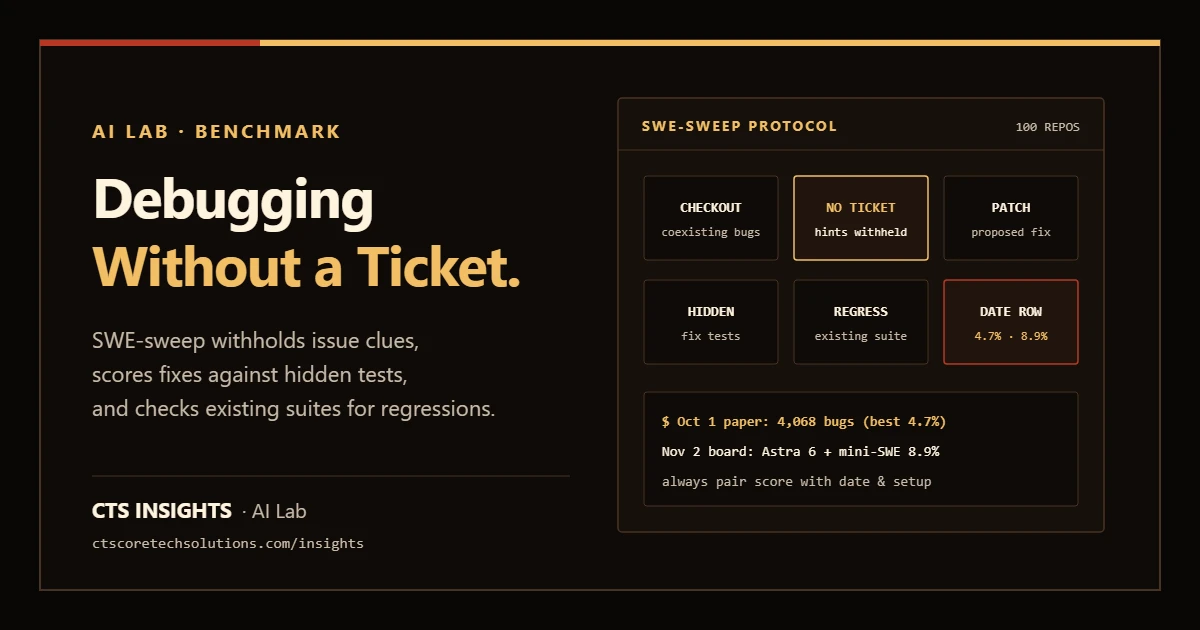
The researchers traced bug reports to the pull requests that fixed them. For each repository, they chose a historical checkout where multiple known bugs coexisted. The agent gets the code without hints about those bugs. The researchers check the submitted changes against hidden tests from the fixes and use the existing suite to check for regressions. A plausible list of things to investigate still leaves the repair unproven. Paper, abstract and section 1
Put a date on the result
The October 1, 2026 paper describes 4,068 bugs across 100 repositories and reports 4.7% as the best result in its evaluation. The project’s leaderboard, updated November 2, 2026, lists Astra 6 with mini-SWE-agent at 8.9% under bugs resolved. If you cite the paper’s result, keep its October date. If you cite the later entry, keep the model and agent names from that row. Original evaluation · Project leaderboard
For your own team, start with the decision you need to make. If the question is whether an assistant can fix a reported export bug, give it the report. If the question is whether it would notice that missing row during maintenance, withhold the clue. Use the same expected export as the check in both cases, and record which assignment you gave.