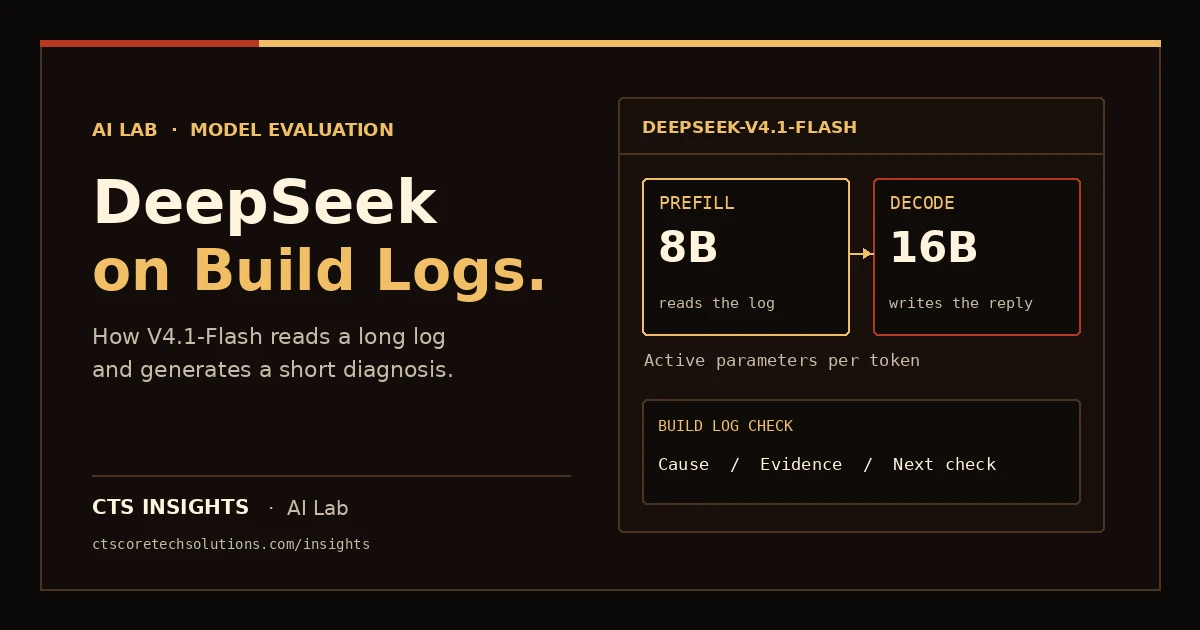
DeepSeek reports 8 billion active parameters per input token and 16 billion per generated token. Here’s why that split matters for a job that reads thousands of lines and produces a short diagnosis.
What the model does with a long prompt
AI inference has two phases. Prefill is the work the model does to process your instructions and inputs. Decode is the work it does to generate the answer one token at a time.
- The encoder reads the input. DeepSeek’s design uses the encoder’s final representations to construct the decoder’s global key-value cache. That cache gives the model information from earlier tokens to refer to as it works.
- Most input tokens skip the full decoder. The model can build the global cache without running every prompt token through the upper layers. It still processes the end of the prompt through decoder layers to prepare local attention, which focuses on nearby tokens.
- The model draws on the cache as it writes. Generation activates about 16 billion parameters per token. The 8 billion prefill figure describes active computation. For a local deployment, size the hardware around the actual checkpoint, runtime memory, and how much context you plan to use.
A build can fail for one reason and log ten more errors
Suppose a build can’t open config/defaults.json. Farther down, the package manager prints Lifecycle script build failed and exits. A diagnosis that quotes only the last line sends you back into the log. A useful answer cites the missing file and suggests checking whether the build bundles it at the expected path.
I’d use a redacted batch of real failures with known causes, plus a log that ends before the cause becomes visible. That last case tells you whether the model can admit it needs another piece of evidence.
A prompt you can try
Add line numbers to the log and give both models the same instructions. Keep the diagnosis short so the comparison reflects the kind of response you’d actually use.
Review this failed build log.

1. Name the most likely cause and quote up to two lines that support it.
2. Identify one later error that is probably a consequence.
3. Suggest one check a developer can run to confirm the cause.

If the cause is unclear, say what evidence is missing. Cite only lines
in the log. Keep the answer under 120 words.

Log:
[Paste the redacted, numbered log here.]
How I’d score the results
- Diagnosis. Did the model find the cause the developer confirmed? On the incomplete log, did it identify the missing evidence?
- Evidence. Do the cited lines exist, and do they support the diagnosis? Could someone run the suggested check?
- Time and cost. Record time to the first streamed token, time to the completed diagnosis, and billed tokens or actual cost. Use the same logs across candidates and record whether each run reused cached input.
DeepSeek’s design makes it a candidate for jobs with long inputs and short outputs. The result I’d use to make a decision is the number of diagnoses a technician can act on, along with the time and cost to get them.
Have a workflow you want to test?
Start with one task, sample inputs, and a clear definition of a good result. See the CTS workflow pilot.